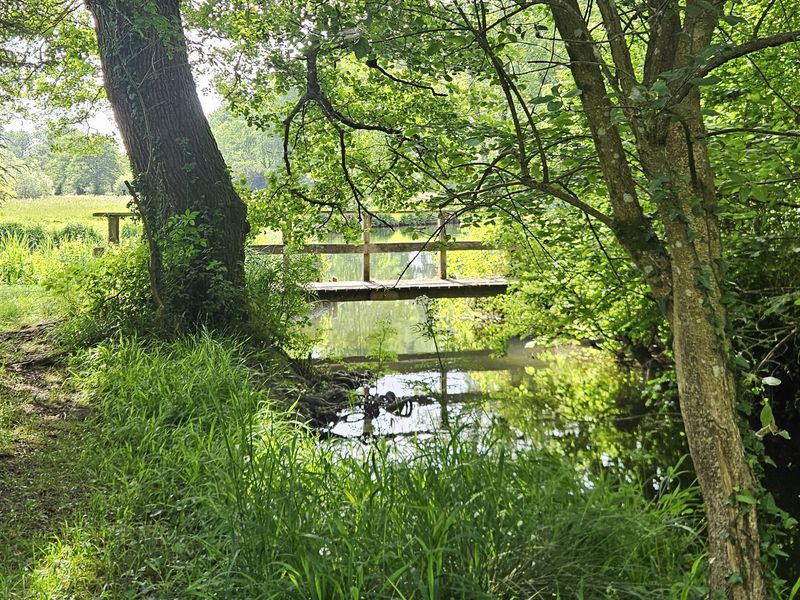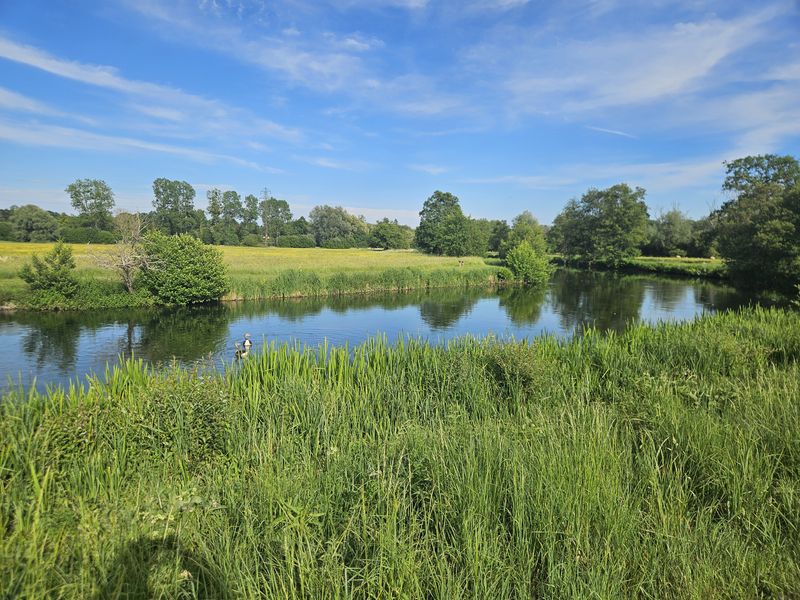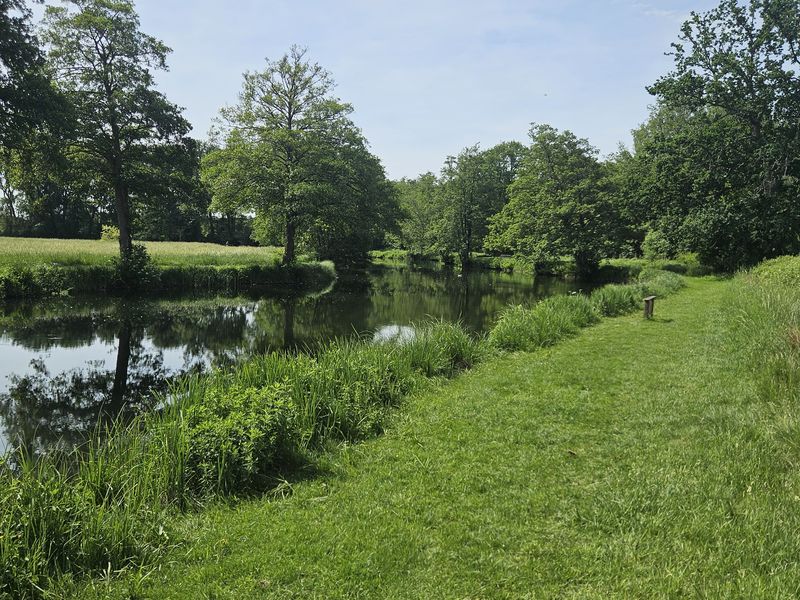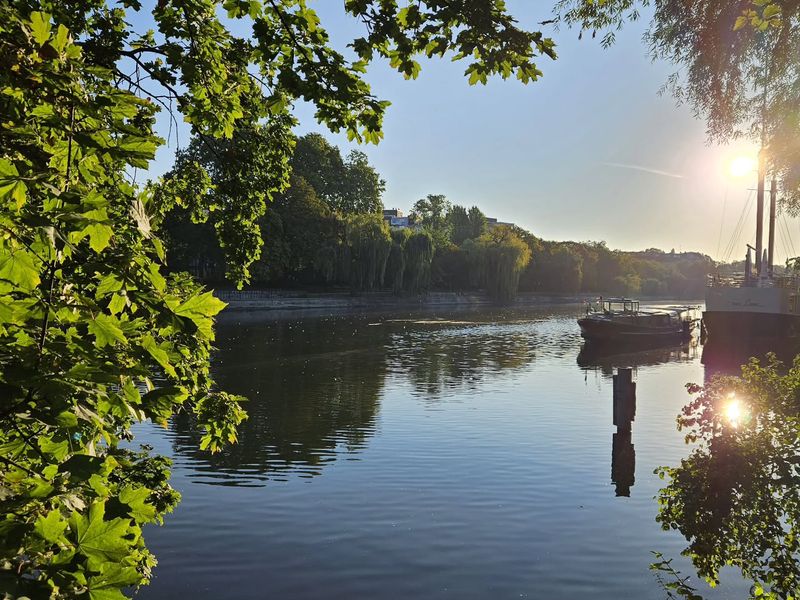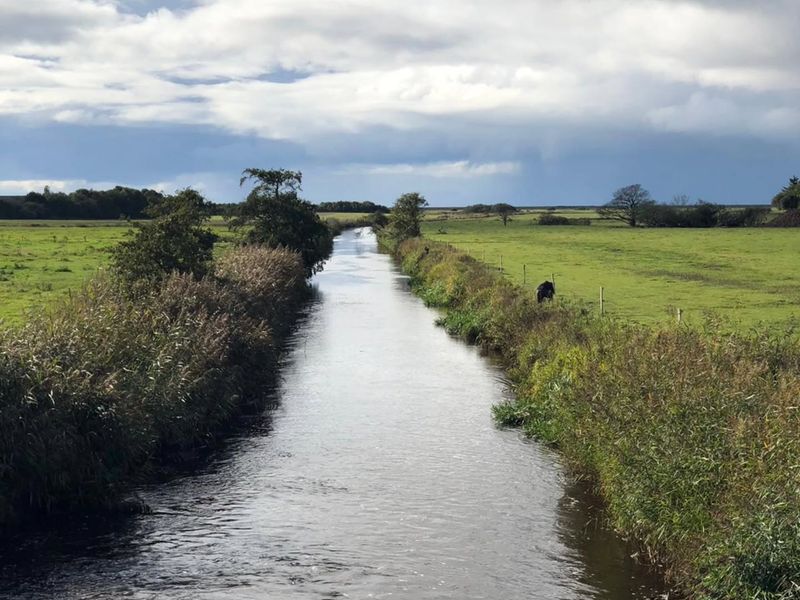
England holds around 85% of the world's chalk streams. Most are in Hampshire, Wiltshire, Berkshire, Dorset and Hertfordshire. The Test, the Itchen, the Kennet, the Avon, the Wylye, the Lambourn, the Dever. These rivers are not simply good fishing. They are a habitat type that barely exists anywhere else on earth.
That's worth sitting with, particularly if you've fished chalk streams for years and the familiarity has worn off the fact. They feel like a given. They are not.
Understanding what makes them what they are explains almost everything about how they fish: why the water is clear, why the temperature barely shifts between June and January, why ranunculus streams from every underwater rock in summer, why the fish are spooky, why the invertebrates are so abundant. It all comes from the same place.
The chalk aquifer: where the water comes from
Every other characteristic of a chalk stream flows from this one, so it's worth being precise about it.
Rain falls on the chalk downlands: the North and South Downs, the Hampshire downs, the Chilterns, the Dorset ridgeway. Chalk is porous. Water seeps down through it slowly, over months, filtering as it goes. It collects in the saturated layer of rock below ground, the chalk aquifer. When the aquifer meets a valley or a fault in the landscape, it emerges as a spring.
A chalk stream is not fed by the rain that fell last week. It is fed by rain that fell last winter, or the winter before. The aquifer buffers and delays everything. Rain-fed rivers respond immediately to weather: a downpour raises them in hours. Chalk streams respond on a geological timescale by comparison, over weeks and months, not hours. This single fact accounts for almost all of the other characteristics that follow.
How this differs from a rain-fed river
Most British trout rivers are rain-fed. They gather water off the surface of hills, moorland and clay, and they answer to the weather within hours. Rain puts them up and colours them. A dry fortnight drops them away. Fishing one well starts with reading what the last few days have done.
A chalk stream barely registers the same weather. The rain that fell yesterday will not reach it for months, and by then it has been filtered, cooled and mixed with everything else in the aquifer.
So on a rain-fed river you watch the forecast. On a chalk stream you watch the season, the hatch and the light, and take the water much as you find it. Everything below follows from that.
Gin-clear water
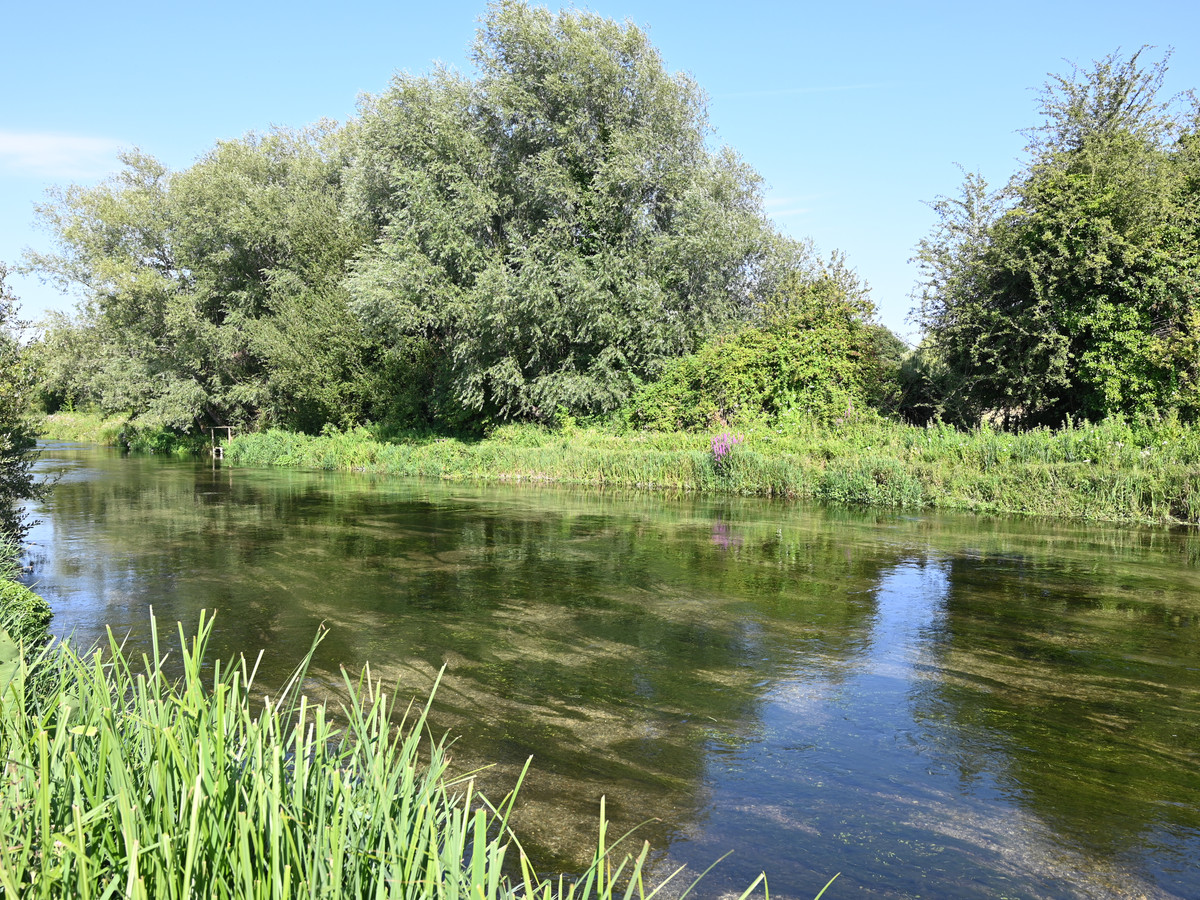
Chalk filters out suspended sediment and particles as water passes through it. By the time the water emerges from a spring, it is almost entirely clear. There is no peat stain, no clay run-off, no turbidity. The water in a chalk stream is usually as clear as water from a tap, often clearer.
The practical consequence is that sight-fishing is possible. You can see fish, identify their feeding position, watch the take. On a calm afternoon in May, you can spot a good trout holding six inches below the surface from thirty yards away.
The other practical consequence is that the fish can see you equally well. They are not forgiving of a heavy footfall on the bank, a shadow thrown across the water, or a poor presentation. Clear water is a double-edged thing. What makes chalk stream fishing technically demanding is largely this.
Steady, cool temperature year-round
Groundwater maintains a near-constant temperature regardless of the season. In England, chalk spring water emerges at roughly 10–12°C throughout the year. In practice this means the rivers run cool in summer and relatively mild in winter.
For trout, the ideal water temperature is somewhere between 8°C and 18°C. On a chalk stream, you are rarely far outside that range. A heat wave that pushes the air temperature past 30°C will warm the water somewhat, but the spring input moderates it. In January, when a rain-fed river might be close to freezing, a chalk stream will be noticeably warmer.
This stable thermal environment suits both fish and invertebrates. It's one of the reasons chalk streams are so productive. The conditions for feeding and growth hold across a much longer portion of the year than on most rivers.
This summer is an exception worth naming. The heatwave running across the UK has pushed water temperatures up even on the chalk streams, and some are now close to 20°C. That spring input still moderates the worst of it, which is exactly why chalk streams hold up better than rain-fed rivers in this kind of weather, but it is not limitless. When the water climbs towards 20°C it holds less oxygen and trout come under real stress. If you are fishing in this heat, it is worth going out early, keeping fish in the water, and thinking hard about whether to fish the warmest stretches at all.
Stable flow
Because the aquifer buffers rainfall over months, chalk streams run at a much more consistent level than surface-fed rivers. A winter of low rainfall shows up as reduced flow in spring and summer; a wet winter shows up as higher flows in the months that follow. But the swings are slow and gradual. A day of heavy rain does not produce a flood. A dry spell of two weeks does not produce a drought.
This stability matters enormously for the ecology. Invertebrates can establish in gravel beds because those beds are not periodically scoured out by spate. Ranunculus can root and grow in the current because the current does not regularly exceed what the plant can hold on to. Spawning beds accumulate clean gravel because the flow is steady enough to keep it there without washing it away or burying it in silt.
It also matters practically for the angler. If you check the gauge on a chalk stream in the morning and it reads a normal level, you can be fairly confident it will read much the same when you arrive in the afternoon. Rain-fed rivers don't often offer that.
Alkaline, mineral-rich water
Water passing through chalk rock picks up calcium carbonate and other dissolved minerals. By the time it reaches the river, it is alkaline, typically with a pH between 7.5 and 8.5. Hard water in the specific sense of the word.
Alkaline, calcium-rich water is extraordinarily good for plant and invertebrate life. It drives photosynthesis in aquatic plants, supports the growth of algae (the base of the food chain), and provides the calcium that invertebrates need for shell and exoskeleton development. A chalk stream running through good land in good condition is, chemically, almost perfectly suited to supporting large populations of insect life.
This is why the trout on a well-maintained chalk stream grow quickly and to good size on wild food. The chemistry makes the habitat rich, and the richness makes the fishing what it is.
Ranunculus: the signature weed
Ranunculus aquatilis and its close relatives, the water crowfoots, are the plants most associated with chalk streams. In early summer, a good chalk stream running between white-flowered ranunculus is one of the more distinctive sights in English fishing. The flowers sit at the surface in clusters; below them, long green ribbons of weed stream in the current, sometimes reaching several metres in length.
Ranunculus thrives in the specific conditions chalk streams provide: clear water (it needs light), cool temperatures, steady flow, and the alkaline chemistry that supports growth. Where those conditions break down, where water becomes turbid, over-enriched with nutrients, or reduced by abstraction, ranunculus retreats and eventually disappears. Its presence is an indicator of river health, and its absence is a reliable sign of a river in trouble.
It does several useful things. It oxygenates the water through photosynthesis. It creates the current structure fish use to hold and feed with minimum effort: the eddies, the cushions of slack water, the narrow threads of faster flow between the weed beds. And it shelters both invertebrates and juvenile fish from predation and current. A chalk stream without ranunculus is a fundamentally different habitat from one full of it.
Clean gravel beds
Because chalk streams run at a steady flow, and because the water carries very little suspended sediment, the gravel on the river bed stays clean. In a spate river, gravel is regularly shifted, buried under silt during high water and scoured clean during floods. In a chalk stream, the gravel accumulates slowly and stays.
Clean gravel is the prerequisite for trout and grayling spawning. Both species dig redds, shallow depressions in the riverbed into which the female deposits eggs and the male fertilises them. The eggs need to be surrounded by water flowing through the gravel to supply oxygen and remove waste. Silt in the gravel reduces that flow and can suffocate eggs before they hatch.
On a chalk stream in good condition, you can see the pale spawning gravels clearly through the water in winter, the depressions where fish have been working. When the habitat is under pressure, through excess run-off from surrounding land or reduced flow that allows silt to settle, that gravel silts up, and recruitment fails. The trout population declines. It is not a gradual or easily reversible process.
Abundant invertebrate life
The combination of clear alkaline water, stable temperature, clean gravel, and ranunculus produces one of the richest freshwater invertebrate communities in the world.
Mayflies, particularly Ephemera danica (the large mayfly), are the most visible. The mayfly hatch in late May and early June is what chalk streams are most famous for, and it is genuinely dramatic, with large duns hatching in numbers and fish feeding hard at the surface through the afternoon. But the mayfly is one species among dozens. Large dark olives (Baetis rhodani) hatch from March onwards. Blue-winged olives (Serratella ignita, long known to anglers as Ephemerella ignita) carry the summer evenings through July and August. The grannom appears in April in quantities that can seem implausible on a river this size.
Freshwater shrimp (Gammarus pulex) live in the weed in extraordinary numbers and form a significant part of the trout's diet through the periods between hatches. Midge and caddis larvae in the gravel add to it further. A chalk stream in good health is producing food almost continuously.
This is why the fish grow. And why fishing a chalk stream well means understanding the insects, not as an academic exercise but because the fish can be feeding on something specific and ignoring everything else.
Wild brown trout and grayling
The species that chalk streams produce are the direct result of everything above. Wild brown trout (Salmo trutta) adapted over centuries to the alkaline, cool, food-rich water. Chalk stream fish have a particular character: selective in feeding, powerful, and well-conditioned on a diet of natural food. A wild chalk stream brown is not a large fish by stillwater standards. A pound and a half is a reasonable fish on many rivers, two pounds a very good one. But it is not a fish you catch by accident.
Grayling (Thymallus thymallus), the "lady of the stream" as they are traditionally known, share the same chalk stream conditions and come into their own through winter when the trout season is closed. They are school fish. When you find them on a run of clean gravel in January, you generally find them in numbers. They are underrated as a target, and worth the attention.
Both species are indicators of the health of what surrounds them. A chalk stream producing genuine wild fish in good numbers is a chalk stream where the habitat is working. When wild populations decline, it is rarely for one reason alone. Usually it is a combination of reduced flow from abstraction, silt, temperature increase, and nutrient enrichment working together over time.
Why this matters
England has about 200 chalk streams by most counts. That is not many. The rivers of the Test valley, the Hampshire Avon, the upper Kennet and the Wylye are the finest examples, but all of them are under some degree of pressure. Over-abstraction of the chalk aquifer to supply drinking water reduces the flow that sustains everything above. Agricultural run-off adds nutrients that tip the chemistry in favour of algae rather than ranunculus. A warming climate compresses the temperature envelope that suits trout.
None of this is irreversible. River keepers and organisations like the Wild Trout Trust are doing the work: restoring ranunculus, de-silting spawning gravels, reducing bankside erosion, making the case to water companies and regulators. Some rivers have improved noticeably in the past decade. The Test's mayfly hatch is more consistent than it was in the 1990s on several stretches, partly as a result of that work.
But these are not rivers that look after themselves without attention. What makes them exceptional, the chemistry, the temperature, the clarity, the invertebrates, is also what makes them sensitive. Understanding what a chalk stream actually is tends to make you more careful with the one you're standing in.