If you've never fished a chalk stream and you've seen the prices, the scepticism is fair. £300 for a day's fishing sounds like a lot for what is, on paper, a small English river. So when you find a beat at £80 or £100, the obvious question is what's wrong with it. What are you missing that the £300 rod gets.
The honest answer is: less than you'd think, and not the water itself.
What the top price is actually buying
A premium beat's price tag isn't really a price on the chalk. The chalk is the chalk everywhere along these rivers, the same springs feeding the same clean, cold, mineral-rich water that grows ranunculus and shrimp and olives in the first place. What you're paying for at the top of the market is name, restricted or exclusive access, intensive riparian management, and heavy stocking density. Those are all real and all cost money to maintain. None of them is the water quality.
A famous middle-Test beat during mayfly can run from about £300 up to £550 a rod, sometimes more for the most exclusive stretches. That's earned money, mostly. But it buys reputation and rod density as much as it buys river.
Drop the postcode and the stocking rate, and the same category of water, spring-fed, weed-thick, full of fly life, is available for a third of that or less. Every one of the beats below is on the budget filter, which lists chalk stream days at £200 or under.
The unstocked Frome
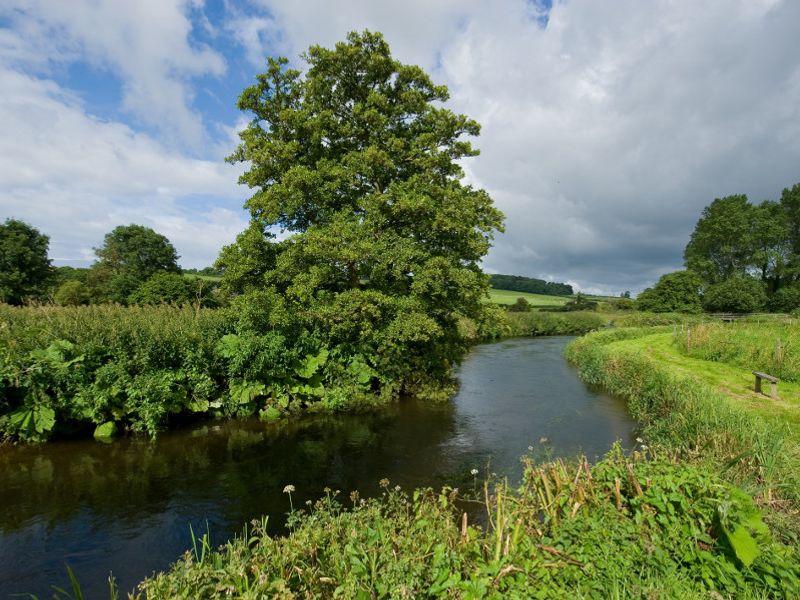
River Frome
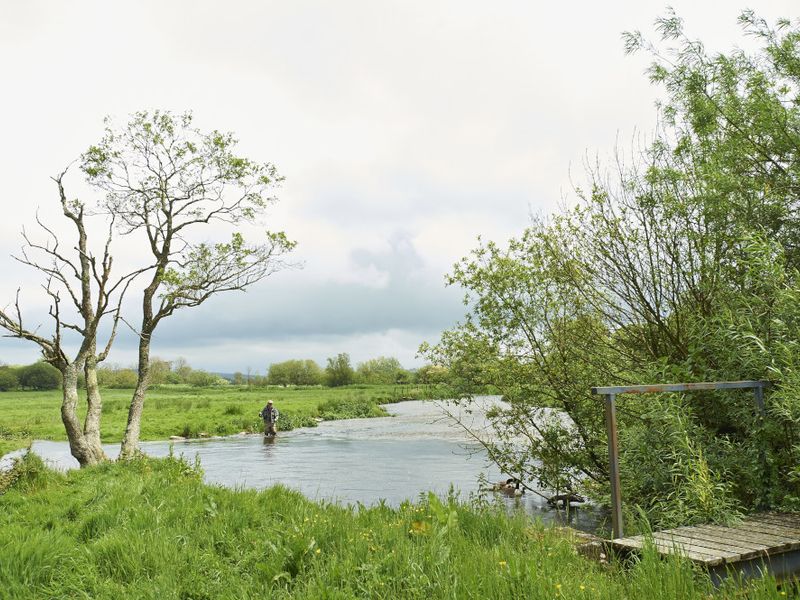
England's most westerly major chalk stream, the River Frome rises from St John's Well in the village of Evershot and runs for 35 miles through the heart of Dorset. From Evershot it passes through Cattistock, Maiden Newton, and Dorchester before broadening across a wide flood plain and meandering through West Stafford and Woodsford to reach Wareham, where it enters Poole Harbour alongside the parallel River Piddle. Compared with most southern chalk streams, the Frome is relatively unaffected by abstraction, which keeps flows consistent and the fishing productive across the full season. Riffles, pools, glides, gravelly runs, and beds of ranunculus characterise the upper and middle river, while the geology shifts east of Dorchester onto sands and clays, giving the lower reaches a distinctly different, broader character. The river holds , and the trout season opens in April with grannom and large dark olives, followed by hawthorn and a reliable mayfly hatch running from mid-May into June. High-summer evenings fish well on pale wateries, blue-winged olives, and sedges that continue into autumn, making September and October worth planning for. Grayling are the river's other notable draw: the Frome has produced the British record three times, most recently a fish of 4lb 8oz taken in 2019, and the winter season runs from mid-June through to mid-March. Upstream dry fly and nymph are the standard methods; some beats permit wading, which opens up water that bank fishing alone cannot cover. The lower river sees runs of salmon and sea trout, though salmon numbers have fallen sharply from a peak of over 4,000 fish in 1988, and the Game and Wildlife Conservation Trust operates a research centre at East Stoke to investigate the decline. The river is designated both a Site of Special Scientific Interest and a Special Area of Conservation, and conservation work led in part by founders of the Wild Trout Trust has helped establish self-sustaining wild trout populations across the Wessex streams. FishingBeats lists 27 beats on the River Frome, covering water from the intimate upper reaches above Maiden Newton to the broader mid-river and lower stretches. Day tickets start from £30. Grayling and winter fishing is available from £35.
The River Frome in Dorset is largely unstocked across its length, which changes the character of the fishing more than the price does. The Wrackleford Estate runs six beats on it, and every one starts at £100 or under for a trout day in April. Gaston Bridge Beat and The Bricks Beat are both from £80. Stratton Beat, Muckleford Beat, 7 Hatches and Wrackleford Home Beat are from £100. The season runs long too: trout from 1 April, then grayling through to 31 January, so there's a lot of year on offer for that money.
Wrackleford Estate
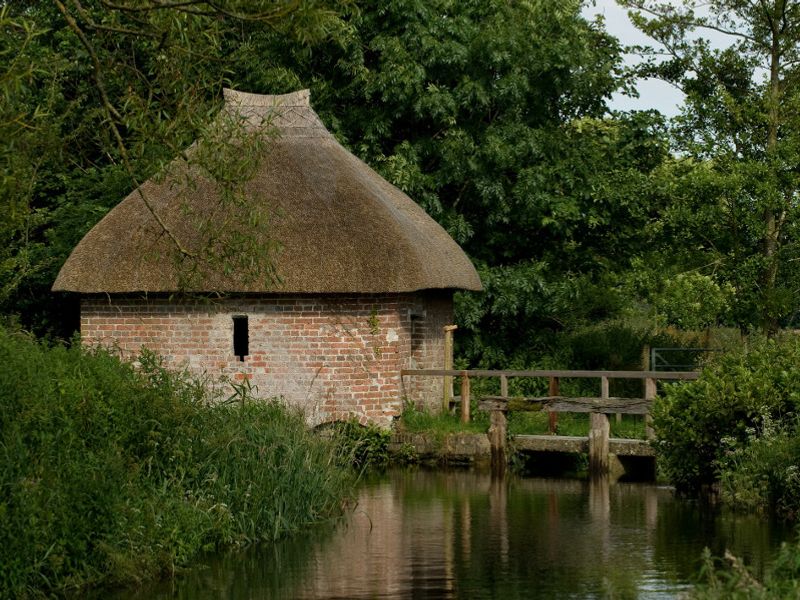
The River Frome is the most westerly of England's chalk streams, and it rises in the chalk downs of west Dorset, maturing into a fine trout river by the time it reaches Wrackleford. The Wrackleford Estate sits in the Frome valley, with the river flowing through a series of water meadows and withybeds just north of Dorchester. Four of the estate's beats — 7 Hatches, Wrackleford Home Beat, Gaston Bridge Beat, and The Bricks Beat — are available on day tickets, with dry fly the required method. The beats vary in character: 7 Hatches covers three-quarters of a mile of main river for a single rod, Wrackleford Home Beat accommodates up to two rods on a similar stretch with a thatched fishing hut, and The Bricks Beat fishes a half-mile section of the Frome carrier. Each beat is well tended, regularly stocked, and has a fishing hut for shelter. Fly hatches occur consistently through the season, including a strong mayfly appearance in early June. Beyond the water, the estate offers tuition from a qualified instructor, equipment hire, and on-site accommodation ranging from B&B to self-catering, with parking, a lodge, kitchen, and picnic tables all available for visiting anglers.
Unstocked water fishes differently to a heavily stocked beat. The fish are wary, the numbers are lower, and you work harder for each one. Some anglers find that a downgrade. Others find it the whole point.
The wild Allen and the insect-rich Lambourn
River Allen
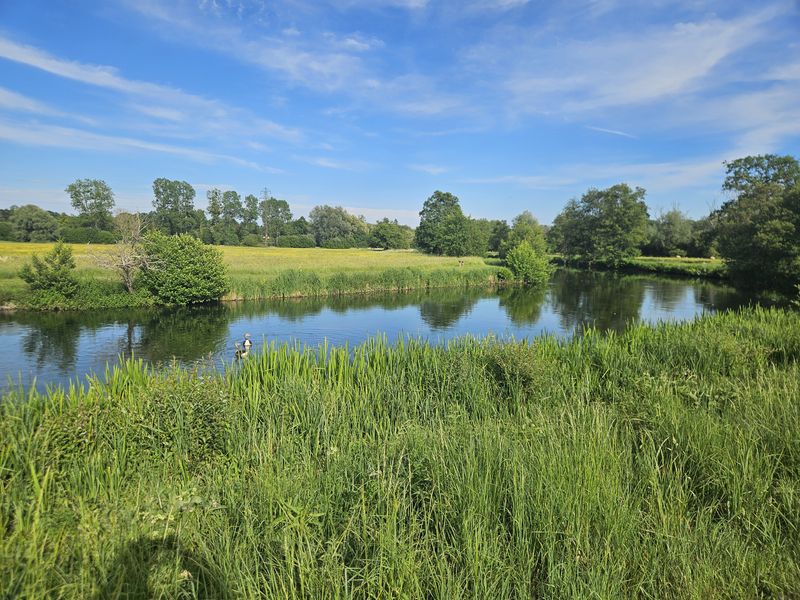
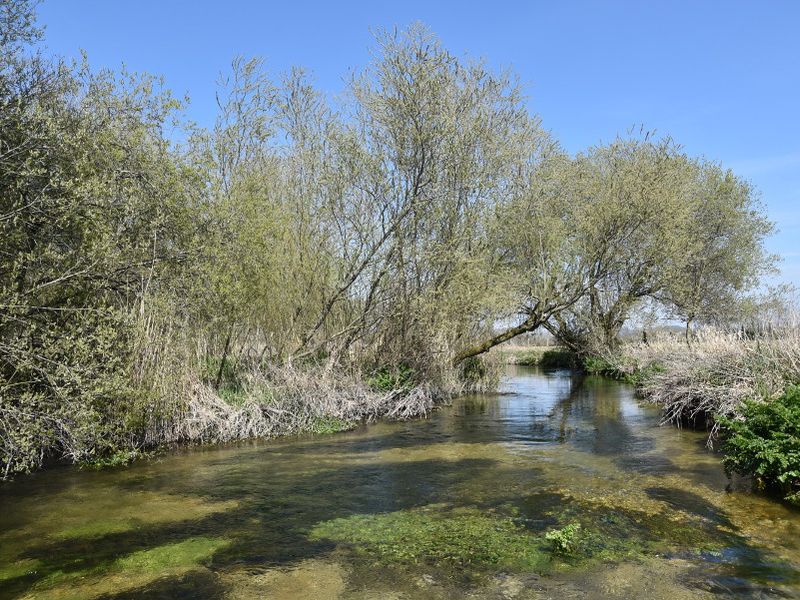
A Dorset chalk stream of 14 miles, the River Allen rises as a winterbourne on the chalk downland of Cranborne Chase near Monkton Up Wimborne and flows south through Wimborne St Giles, gathering the Gussage Stream and the Crichel Stream along the way, before passing through Witchampton and Hinton Parva to meet the River Stour at Wimborne Minster. The river runs on the dip slope of the downland, and the landscape transitions from chalk downland to broad valley as it approaches its lower reaches. Throughout its length it runs through the Cranborne Chase Area of Outstanding Natural Beauty, surrounded largely by private estate land. The River Allen carries a strong reputation as a Wessex chalk stream fishery supporting good stocks of wild brown trout, as well as grayling and indigenous coarse fish. The mayfly hatch is often spectacular, typically peaking in early June, with blue-winged olive and pale watery among the characteristic upwing hatches through summer. The Allen runs gin clear, and the river is narrow and heavily vegetated, demanding real stealth from visiting anglers. Fish lie in tricky spots, and upstream dry fly is the primary method, with nymphing coming into its own through late summer and autumn. A small group of locals, some of whom went on to found the Wild Trout Trust, were at the forefront of the drive to protect and improve the river, and it now holds a healthy, self-sustaining wild trout population. The Allen is also subject to a major restoration project led by Dorset Wildlife Trust with funding from Wessex Water and the Dorset Area of Outstanding Natural Beauty. Of all the English chalk streams, the Allen is one of the most private, with nearly its entire length under the ownership of just two large estates that have been in the same family for many generations. Deans Court is a pivotal part of a Landscape Recovery Scheme that, over the next two decades, seeks to restore the water meadows and improve habitat for insects and wildlife along the River Allen corridor. 4 beats are currently listed on FishingBeats, offering rare day-ticket access to one of Dorset's most tightly held chalk streams. Day tickets start from £75.
Dorset's River Allen is smaller and much less known than the Test, which keeps its prices down without touching its quality. The Shaftesbury Estate's Wimborne St. Giles - Home Beats are lightly stocked over a strong wild population, all catch and release, from £75. Deans Court , further down the same river, is entirely wild fish, from £95.
River Lambourn
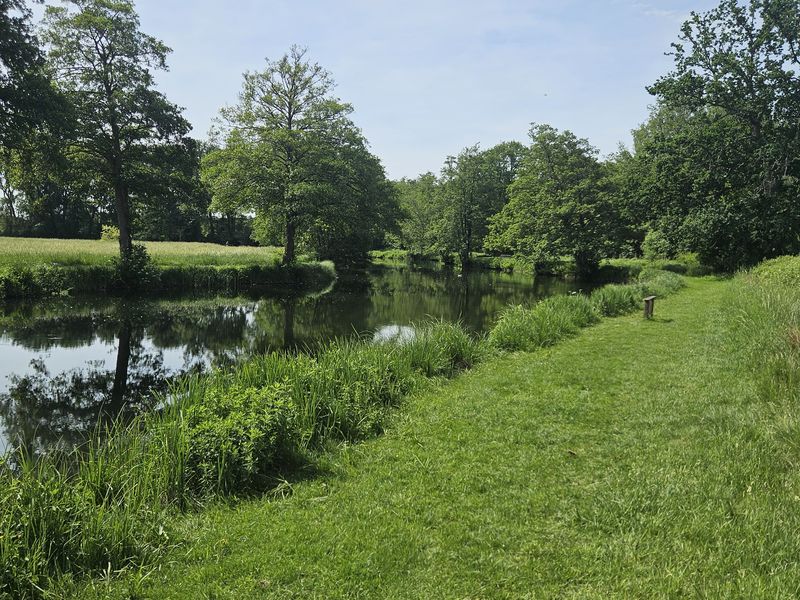
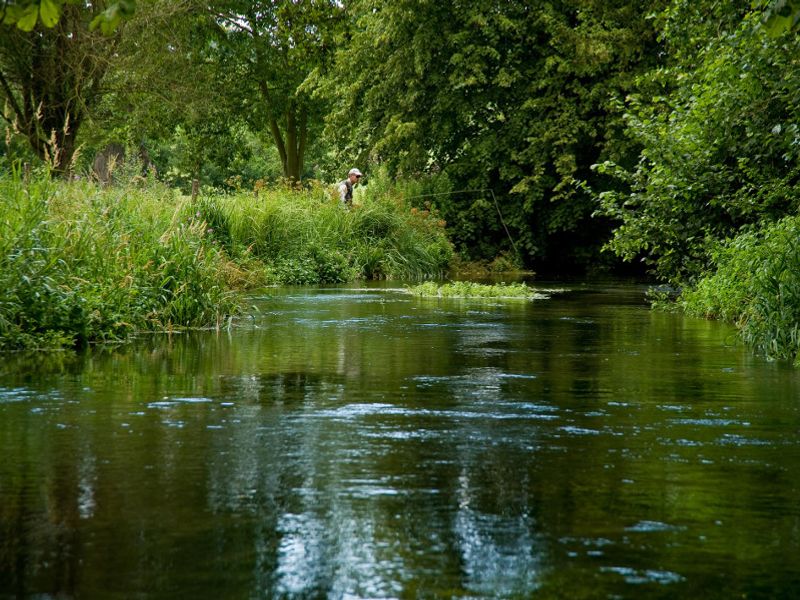
A Berkshire chalk stream of around 15 miles, the River Lambourn rises in the Berkshire Downs near its namesake village of Lambourn and flows as a tributary of the River Kennet. Powered entirely from chalk springs, the river produces gin-clear water and year-round stable temperatures. Its flow regime remains near-natural in form, not being significantly modified by groundwater abstraction, which is notable given that the upper reaches are seasonal, with a perennial source derived from springs located upstream of Great Shefford. The river passes through the villages of Eastbury, East Garston, Great Shefford, Welford, Boxford, Bagnor and Donnington before meeting the Kennet at Newbury. The river supports one of the best and most productive fisheries for wild brown trout in the area, with natural populations of grayling also present. The Lambourn sits in the top 10% for England and Wales for the number of macroinvertebrate families recorded, with five nationally rare invertebrate species associated with the river, a measure of the insect life that sustains its hatches. The season opens in April; expect hawthorn early on, followed by a mayfly hatch and then a mixture of olives, sedges and terrestrials later in the year. Grayling fishing extends the season through winter. Small and fast-flowing, the river is a classic chalk stream where clear water and ranunculus beds demand accurate dry fly or nymph presentation and a careful approach to each fish. The River Lambourn is designated as both a Site of Special Scientific Interest and a Special Area of Conservation. The river receives road runoff from the M4, and sediment sampling in 2015 showed the presence of heavy metals and other toxins, with turbidity downstream of the M4 discharge recorded at 200 times greater than upstream during rain events. Ongoing work by Action for the River Kennet and partners continues to address fish passage and habitat quality. Many stretches are held by private syndicates, with only a few open to the public. FishingBeats currently lists 5 beat on the River Lambourn, offering rare day-ticket access to this tightly held Berkshire chalk stream. Day tickets start at £93.
On the Berkshire Lambourn, Donnington Grove is from £93 across early and main season. It's lightly stocked, and its listing puts it in the top 10% of English and Welsh rivers for macroinvertebrate families, which is a proper way of saying the insect life is genuinely good. If you're fishing for the hatch as much as for the fish, that number matters more than the price does.
None of these three rivers has the Test's reputation. That's most of why they're cheaper.
What you do give up
It would be dishonest to say a £100 day and a £300 day are the same experience with a different number attached. They're not, and the differences are worth knowing before you book.
You'll usually be fishing over fewer stocked fish per rod, which can mean a harder day and a lower catch count, particularly on the wild-only beats where every fish has to be earned rather than met halfway. Beats at this price tend to be smaller and single-bank rather than the double-bank, mile-plus stretches that the premium water often offers. On-site infrastructure is more modest too: you're less likely to find a ghillie on hand, a proper fishing hut, or the kind of white-glove service that comes with the famous names. And the names themselves matter to some anglers. There's a genuine appeal in saying you fished a stretch with two hundred years of history attached to it, and that appeal has a price.
None of that is the chalk stream itself changing. It's the service wrapped around it.
Choose by the water, not the price tag
If what you want is the classic chalk stream experience, clear water over gravel and weed, wild or lightly-stocked brown trout, insect life thick enough to bring fish up in the evening, that's available at £80 to £100 as reliably as it is at £300. What changes with the price is stocking density, exclusivity, infrastructure and reputation, not whether the river is doing its job. We’ll try to extend the list of more affordable beats here.
We wrote about this from the other direction in affordable fishing on the river Test: even the most expensive-looking river on paper has beats sitting well under £200, on the same water, a few miles from the famous names. And the wider argument for the whole chalk stream network is in where to find affordable chalkstream fishing.