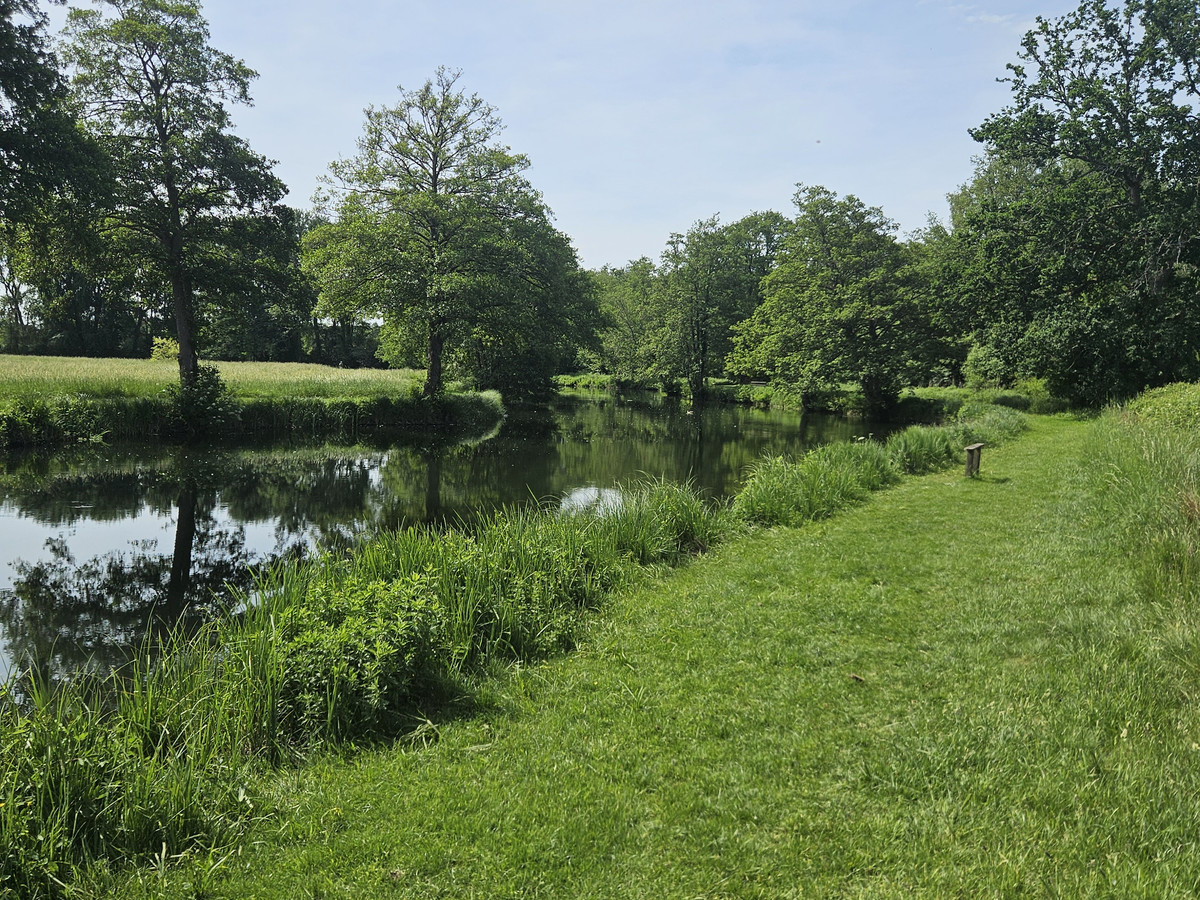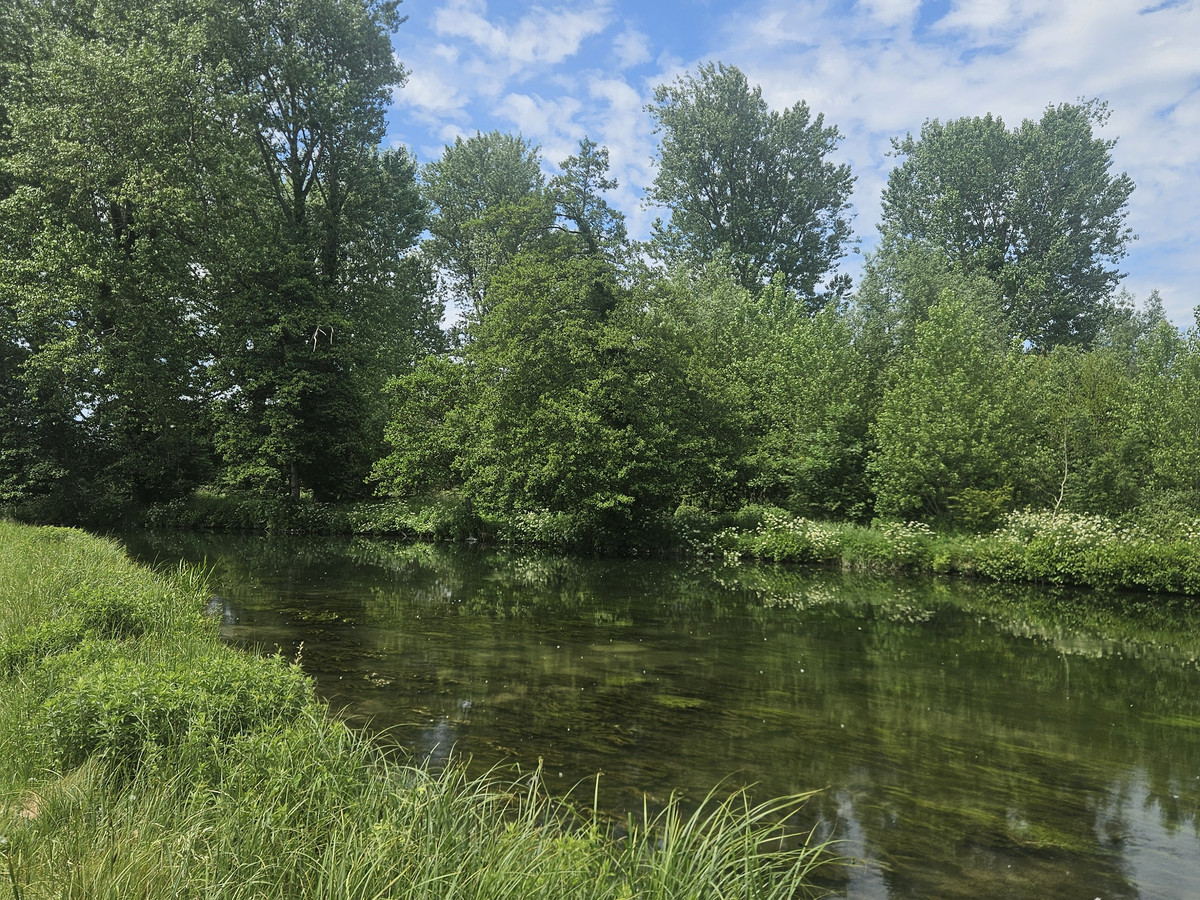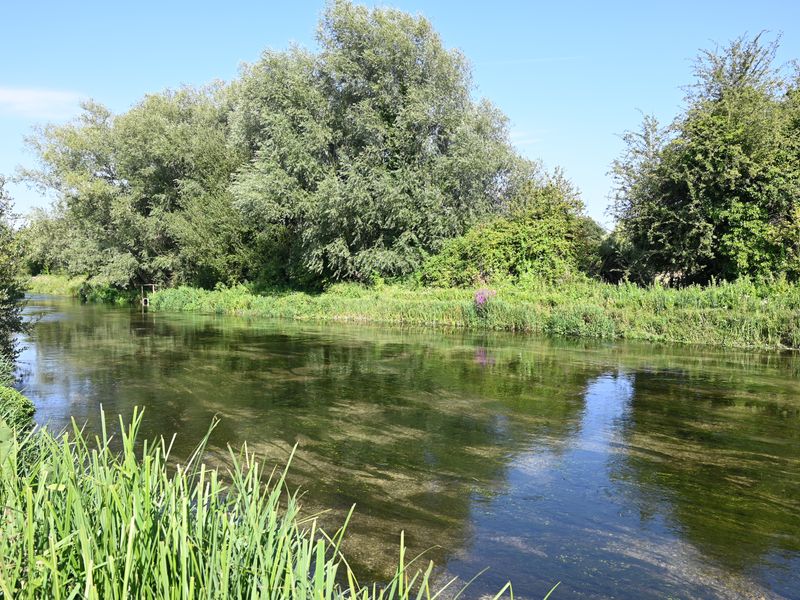
In the last piece I went through why chalk streams are clear, cold and full of fish: the water falls as rain on the downs, filters down through the chalk over months, and comes back up through springs already clean, cool and full of dissolved minerals. That is the geology. This piece is the consequence of it.
Because every one of those features shows up as something you have to deal with on the day. The clarity means the fish can see you. The steady flow means weed grows in long beds that split the river into separate currents. The mineral-rich water means the river grows its own food in quantity, so the fish can afford to be fussy about which bit of it they eat. None of that is abstract. It decides where you stand, what you tie on, and whether the first cast is the one that counts.
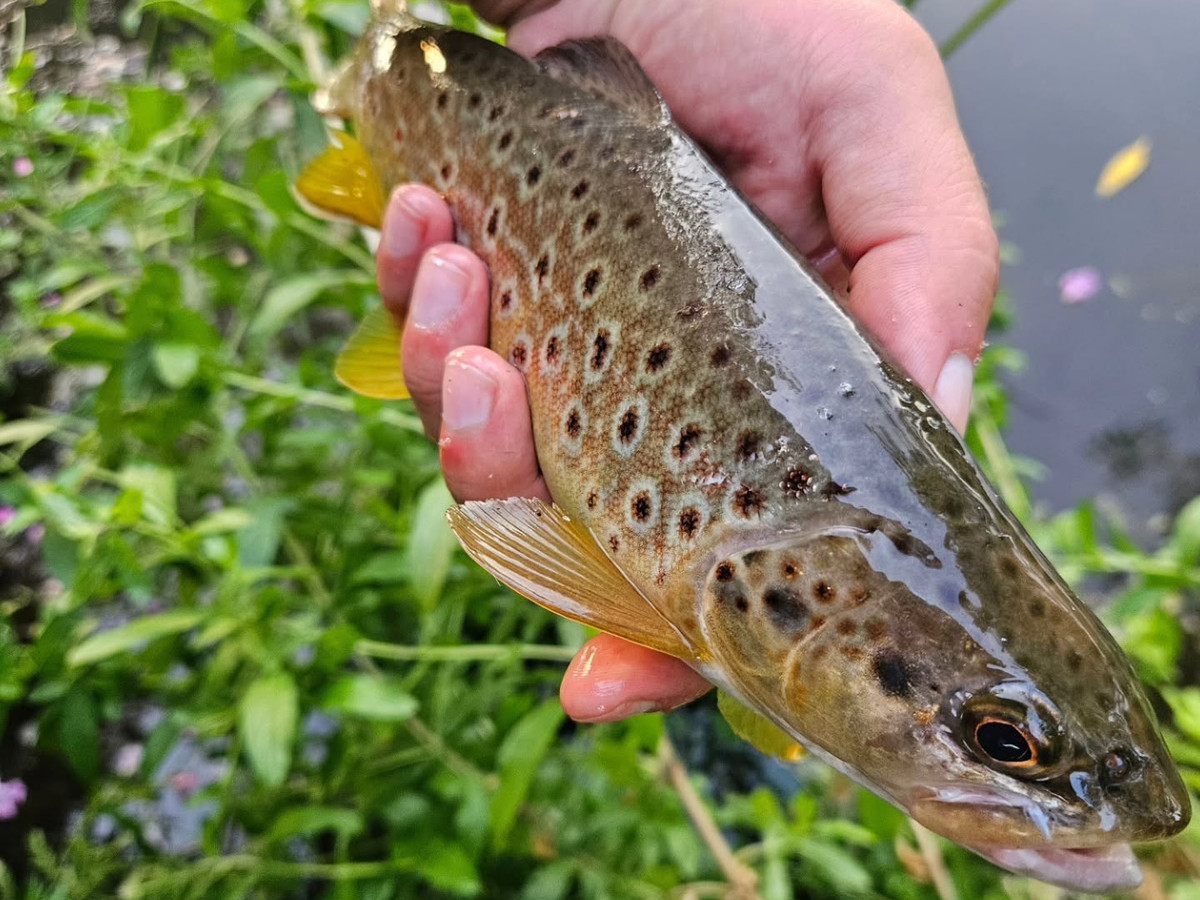
Chalk streams are not difficult in the way that big water is difficult. You are rarely casting far. The fish are not large by stillwater standards, and a pound and a half is a good one on most of these rivers. What makes them demanding is that they ask you to make decisions before you make a cast, and they punish the ones you get wrong more obviously than a coloured spate river ever would.
Here is how they actually fish.
A plan beats a long cast
The single most useful habit on a chalk stream is stopping before you start.
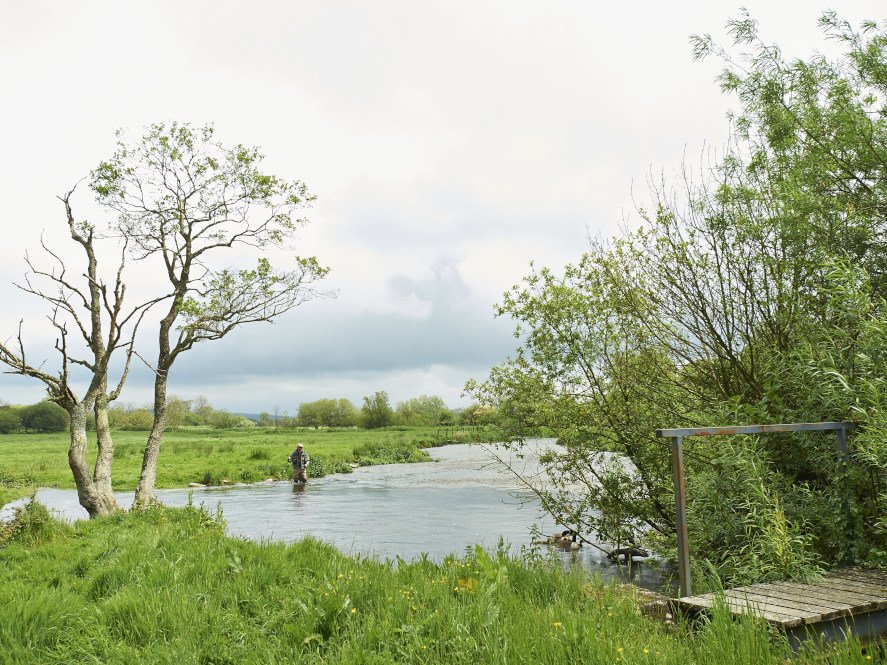
Most of the water you can reach is within thirty feet. A lot of it is within twenty. Distance casting is close to irrelevant, and on the narrower carriers it is a liability, because a long line lands with more slack than you can control and drags before the fly has drifted a yard. What matters instead is accuracy, and what enables accuracy is knowing where you intend the fly to land before you pick the rod up.
So the sequence that works is: look, then decide, then cast. Watch a stretch for a few minutes. Find the current lanes. Find a fish if you can, or the lie where one should be. Work out where you need to be standing to present to it without the line crossing a faster current on the way. Then move into that position, quietly, and make the first cast the one you meant to make.
On these rivers the first cast is usually the best cast you will get at a given fish. A trout that has seen a fly land badly, or a line land on top of it, will often go down for twenty minutes even if it has not been properly frightened. That is not a reason to be precious about it, and nobody casts perfectly. It is a reason to spend the free time, the time before you cast, on the part of the job that is actually free.
Clear water cuts both ways
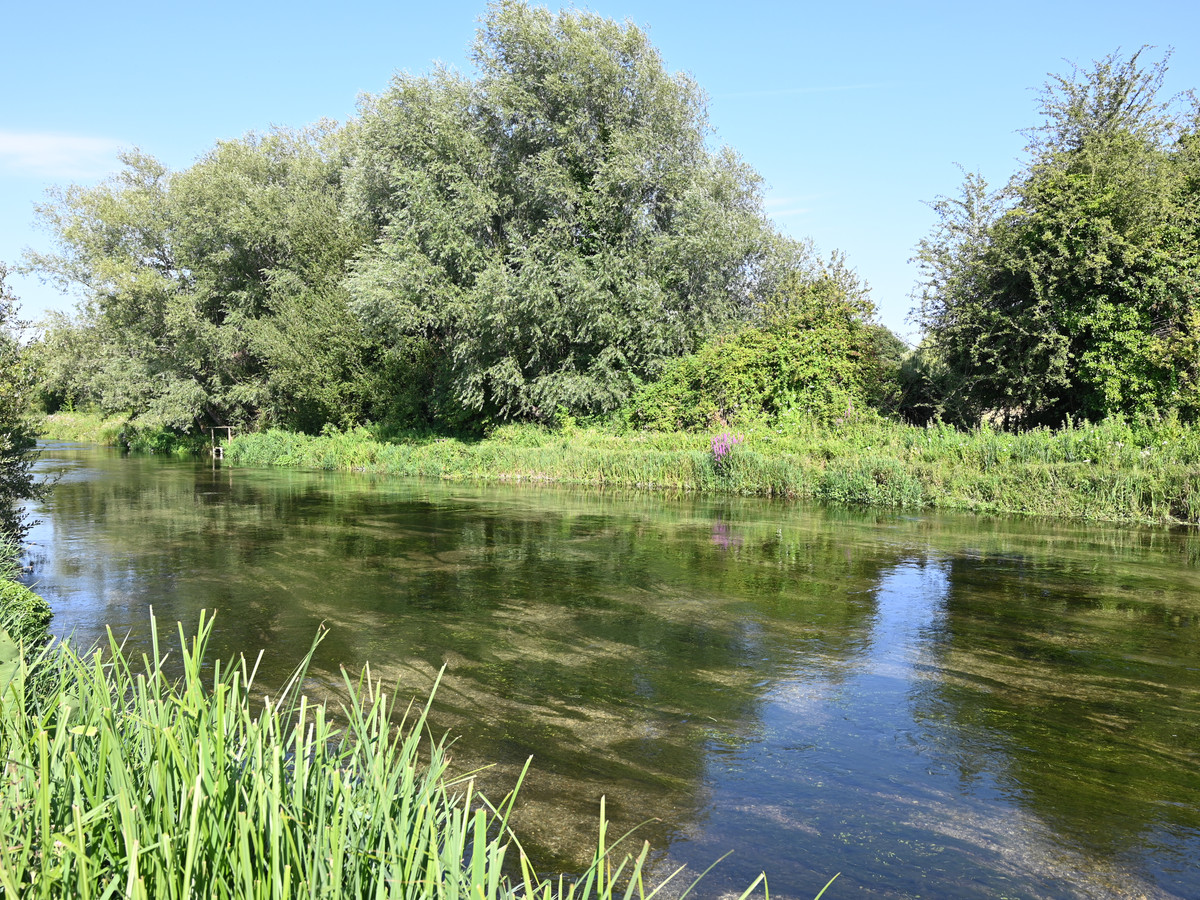
Chalk stream water carries almost no suspended silt, which is why you can stand on a bridge and count fish. It also means they can count you.
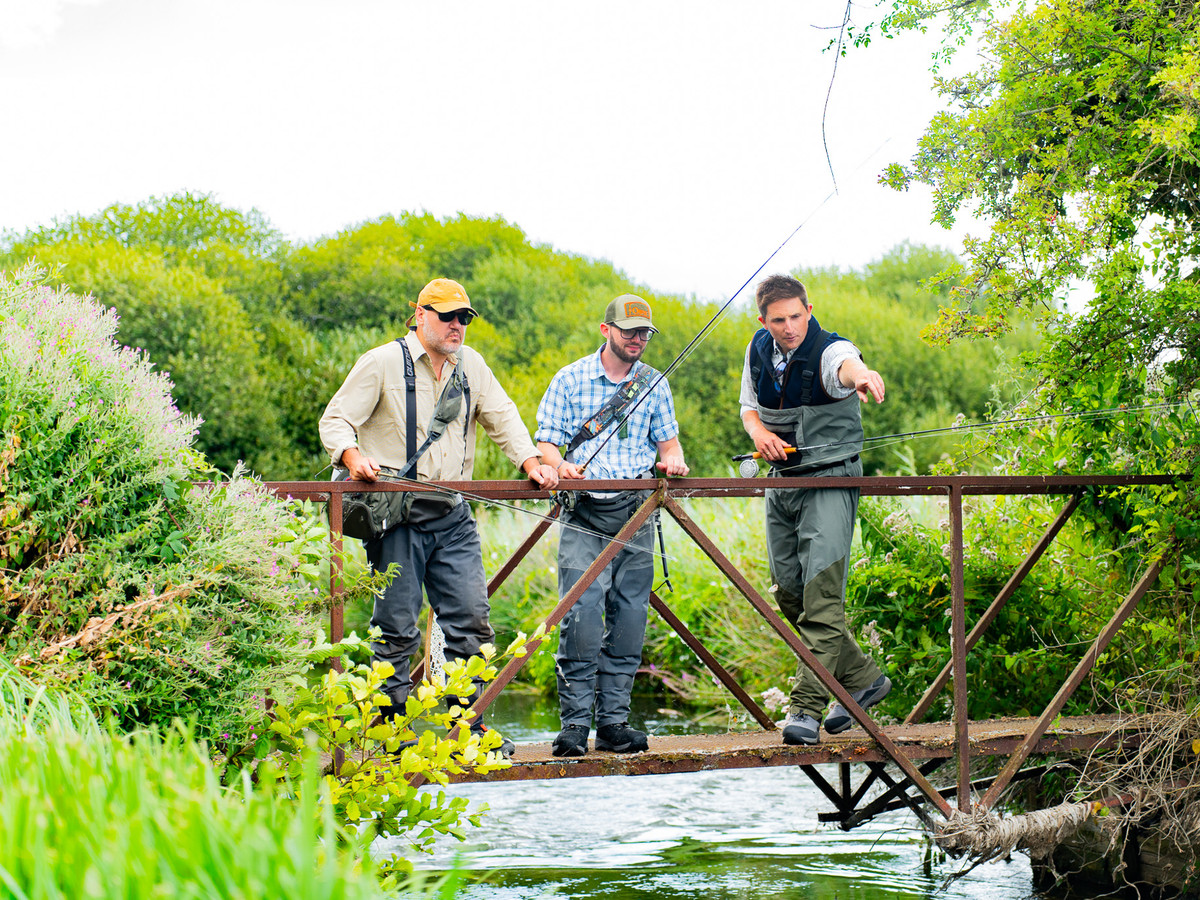
Source: Wilde Trout
It helps to know roughly what a trout can see. Light bends as it enters water, so a fish looking up sees the whole world above the surface squeezed into a cone of about 97 degrees. That cone meets the surface as a circular window, and the window is roughly twice as wide as the fish is deep. A trout holding a foot down is watching a patch of sky a bit over two feet across. Outside that circle, the underside of the surface acts as a mirror and shows it the riverbed instead.
Three practical things follow from that.
A deep fish sees more of the bank than a shallow one. A trout lying in three feet of water has a window six or seven feet across and will clock you standing upright well back from the edge. A fish sitting inches under the surface in a weed lane has a tiny window and is effectively looking at a postage stamp of sky, which is why you can sometimes get absurdly close to a shallow feeding fish if you keep low and slow.
Low is better than far. Getting your outline below the skyline does more than adding ten feet of distance. Kneeling, crouching, or simply standing in front of a bush rather than against open sky changes what the fish has to work with. Drab clothing helps for the same reason. None of this needs to be elaborate, and I am not suggesting you crawl up a riverbank in camouflage. Just do not walk up to the edge and stand there in a pale jacket.
Watch your shadow, and watch your line. A shadow sweeping across the water will empty a pool faster than a bad cast. Where you have a choice, fish with the sun in front of you rather than behind you, which keeps your shadow behind you as well and gives you better light for spotting fish. False casting over a fish is the other common giveaway, because a bright line flashing overhead is exactly the shape of a bird. If you need to lengthen line, do it off to one side, over the bank if you can.
The last one is not about sight at all. Trout feel vibration through the lateral line, and a chalk stream bank is often soft, undercut and hollow underneath. Heavy footfall carries. Walking softly along the last few yards is worth as much as anything you do with the rod.
Start farther back than feels necessary
Here is the mistake almost everyone makes, including me, more often than I would like: you arrive at a nice-looking run, walk to the edge to get a proper look, and put down the two fish that were feeding in the three feet of water you are now standing over.
The near water holds fish. On a chalk stream it often holds the best ones, because the margins have weed cover, undercut banks, and a steady conveyor of shrimp coming out of the weed. Fish in the margins are also the least disturbed, because most anglers walk past them on the way to the middle.
So work near to far, and low to high. Fish the water at your feet before you fish the water across the river. Give the closest good lie the first cast, before you wade through it or lean over it. Then extend, then move up.
Stopping short of the edge is the physical version of the same idea. Get into casting position a yard or two back from where you would naturally stand. You will lose a little line control and gain a lot of fish. If you need to see into the water to find a fish, do that from farther back and from a higher angle first, with polarised glasses, then drop down low to make the cast.
Ranunculus rewrites the current
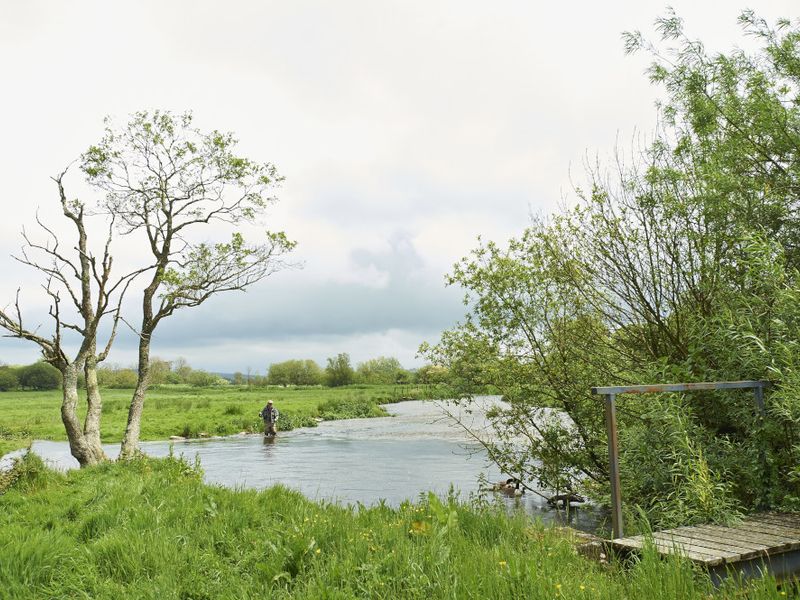
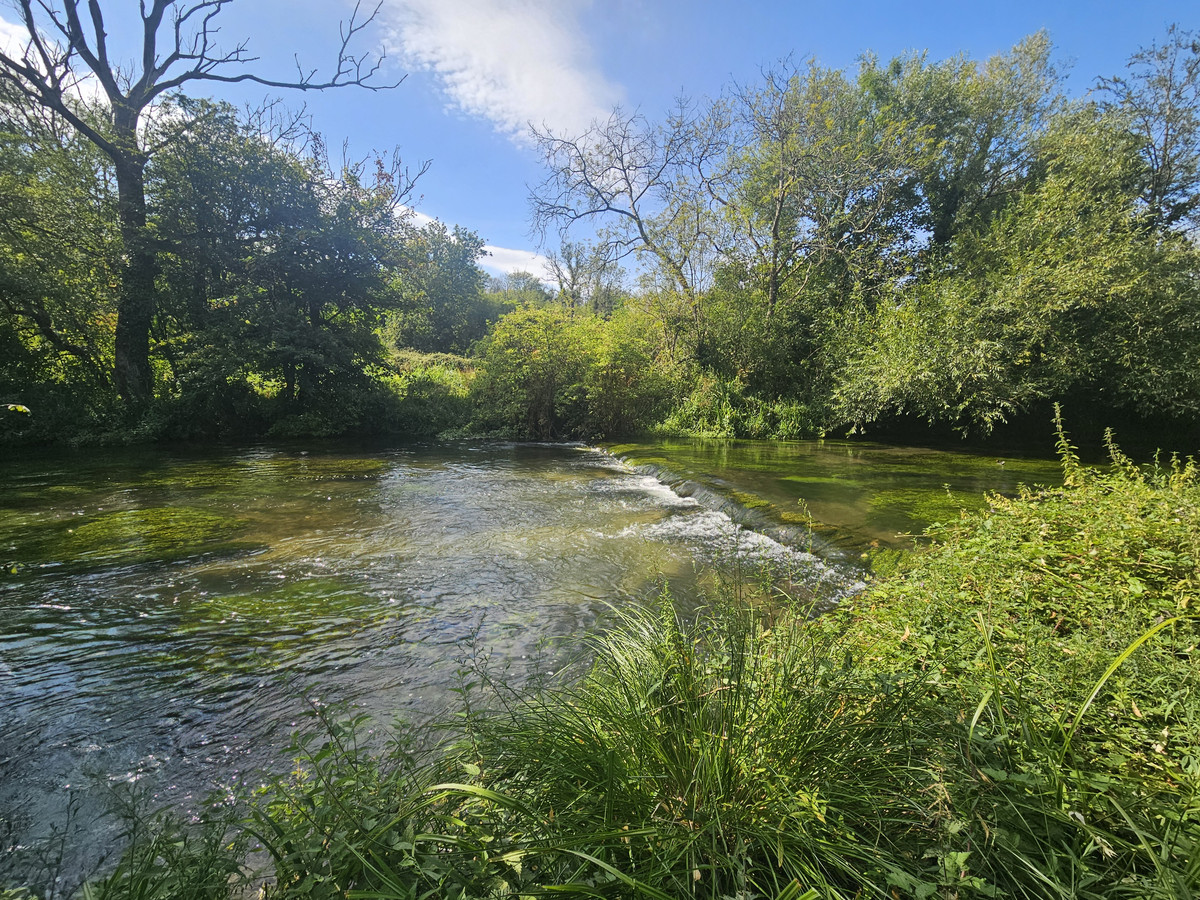
In summer a healthy chalk stream is not one current. It is a dozen.
The water crowfoot that gives these rivers their look grows in long beds that trail downstream, sometimes several metres of it, and the flow has to go around and between. What you end up with is a braid: narrow threads of fast water running down the gaps between the beds, cushions of slower water in front of each bed where the flow piles up, soft tails of slack behind them, and quiet pockets along the bank.
That structure is the whole game, for two reasons.
It puts the food in the fast lanes and the fish beside them. Drifting insects go where the current goes, so the gaps between weed beds are conveyor belts. Holding in the middle of a fast lane costs a trout energy, so it does the sensible thing and sits on the edge of the lane, or in the cushion at the head of a bed, or in a pocket just off the seam, and moves out sideways to intercept. When you look at a weed lane, the feeding station is almost never in the middle of the current. It is on the boundary between fast and slow.
It creates drag. Drag is the single biggest cause of refusals on these rivers, and weed beds are the reason. If your fly is in a fast thread and your line is lying across a slow one, the line gets pulled downstream at a different speed, tightens the leader, and skates the fly across the surface in a way no natural insect does. A trout will watch that fly go past and do nothing. Often it will do nothing for a long time afterwards.
The fix is slack in the right places. Cast so the fly lands with the leader in loose curves rather than straight, and so that as little line as possible crosses a current moving at a different speed. A reach cast, where you lay the rod tip over upstream as the line unrolls, puts the line up-current of the fly and buys you a longer drift. A wiggle in the delivery does something similar. Fishing from a position where the fly and the line are in the same thread of water solves it more simply, which is why the choice of where to stand matters as much as the cast itself.
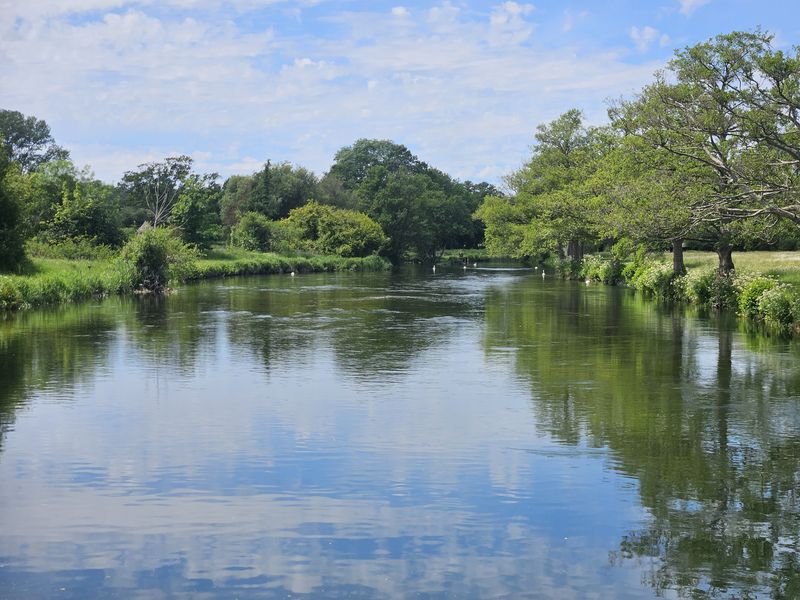
River Test
Rising at Ashe, near Overton, the River Test runs for 40 miles through Hampshire, flowing south through Whitchurch, Longparish, and Wherwell before the Rivers Dever and Anton join the main channel near Chilbolton. For much of its length the Test is not one river but an amalgam of main channel, mill leats, carriers, and side streams, with two, three, or even four streams running parallel, all fishable, and it can be difficult to distinguish carrier from main river. The valley broadens through Stockbridge and Houghton before the Wallop Brook and River Dun add their flow near Kimbridge and Romsey, with the Test finally becoming a single channel only south of Romsey, a few miles from the sea. The river is one of only 12 chalk streams classified as a Site of Special Scientific Interest and one of only six that supports Atlantic salmon. It is recognised as being particularly sensitive to phosphate pollution, and conservation work by riparian owners, river keepers, and the Test and Itchen Association remains central to maintaining its ecology. It was on the banks of the River Test that Frederick Halford honed his ground-breaking ideas that effectively invented modern dry fly fishing in the late 1800s. That tradition still defines how most beats are fished: upstream dry fly and nymph, presented to visible, rising fish. The river supports over half a dozen species of stonefly, twenty-two species of mayfly, and nearly forty species of caddis fly, with grannom and hawthorn fly opening the season in spring and the mayfly hatch in late May drawing anglers from across the country. Wild brown trout are the primary quarry through the trout season, with Atlantic Salmon, Brown Trout, Grayling, Rainbow Trout, Sea Trout all present across the valley. The river holds good populations of wild brown trout and grayling alongside stocked fish, and the salmon beats carry genuine holding pools. Grayling provide sport on dry fly and nymph into winter once the trout season closes. With 75 beats across 12 fisheries listed on FishingBeats, access to the River Test is broader than its private reputation might suggest. Kimbridge Estate offers seven miles of fishable bank managed to maintain a purist upstream dry fly fishery, while the Broadlands Estate extends for two and a half miles divided into dedicated trout beats and salmon beats. The Leckford Estate on the middle Test, north of Stockbridge, has 16 fishing beats open to anglers from May to October. Day tickets, season rods, and syndicate shares are all available across the valley.
Where the fish actually are
Trout hold where the food arrives and the effort is low, with somewhere to bolt to if something goes wrong. On a chalk stream, the places that combine all three are fairly consistent.
- The edges of weed lanes. Covered above, and the most common feeding station on the river through summer.
- In front of a weed bed. Water piling against the bed creates a slow cushion, sometimes only a foot of it. A fish sits there in almost no current with the whole lane arriving at its nose.
- The tail of a weed bed. Slack water with cover directly over it. Often a holding lie rather than a feeding one, which means a fish there may not be looking up, but it is a good place for a nymph.
- Along an undercut bank. Particularly on outside bends. Cover, shade, slow water, and shrimp dropping in off the bankside weed. These fish are hard to present to without lining them, which is exactly why they get to be good fish.
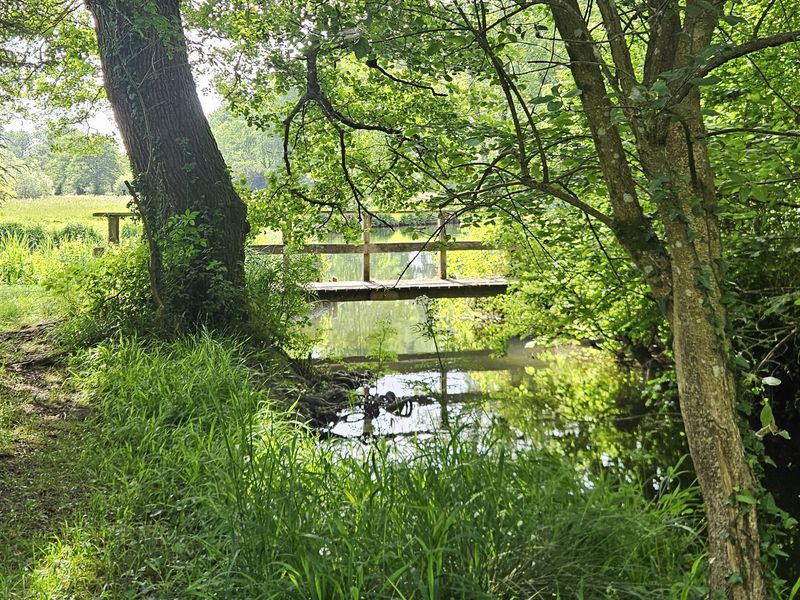
- Under trees and overhanging cover. Shade, terrestrial insects falling in, and safety. Difficult casting, and worth the trouble.
- The crease below a bridge, hatch pool or sluice. Faster water pinches in and then spreads, creating a defined seam and some depth. These are obvious to everyone and get fished hard, but they hold fish for a reason.
- Gravel runs and shallow glides. Easy to overlook because they look featureless. On a bright day a trout on clean gravel is almost invisible until it moves. Look for the shadow rather than the fish, and for the flicker of a fish turning to take something.
Two more things belong here. A fish that is feeding will be holding higher in the water than a fish that is not, and it will move regularly to a rhythm. A fish that is sitting hard on the bottom is not interested in your dry fly. And a bow wave heading upstream tells you something too, because a spooked fish usually means you have arrived in the wrong order, but it also tells you the water holds fish and the next pool up deserves a more careful approach.
The river grows its own food
Chalk streams are among the most productive freshwater habitats anywhere, and that changes how you choose a fly.
On a poor river, the fish eat what turns up, and a rough approximation of an insect often does the job. On a chalk stream, there is so much food that a trout can specialise. It will lock on to one species, at one stage of that species’ life, and ignore everything else on the water including your extremely reasonable Adams. That is not the fish being difficult. It is the fish doing the efficient thing when it has forty identical items a minute going past.
The food comes in three broad places.
- In the weed. Freshwater shrimp, Gammarus pulex, live in the ranunculus in enormous numbers and are a staple between hatches. Shrimp get dislodged and drift, which is why a shrimp pattern fished dead drift along a weed edge is such a reliable searching fly when nothing is hatching. Snails and caddis larvae are in there too.
- In the gravel. Nymphs and larvae live in the clean gravel of the bed, and trout root them out or take them as they drift. A fish feeding on nymphs close to the bottom often gives itself away by tilting and flashing its flank.
- On and above the surface. Duns hatching off, spinners falling spent, sedges skating at dusk, and terrestrials blown in off the bank.
The practical skill is working out which of the three you are looking at, and the rise form usually tells you. It is worth learning to read, because it costs nothing and saves you an hour of changing flies.
- A quiet sip, with the nose barely breaking, and a ring that spreads slowly. The fish is taking something in or on the film that cannot escape: a spent spinner, a stuck emerger, a small dun. Fish something low in the surface rather than a high-riding dry.
- A head and tail roll, where you see the head come up and the dorsal and tail follow. Classic emerger feeding. The fish is intercepting insects hanging in the film, and it is moving through a slow arc rather than snatching. An emerger or a Klinkåmer style fly is the answer more often than a dun is.
- A splashy slash, sometimes with the fish leaving the water. Something is escaping. Usually a sedge running on the surface, most often at dusk, occasionally a fast-hatching olive. A skated or twitched fly can be right here, which is one of the few times on a chalk stream that movement helps rather than hurts.
- A boil or bulge with no break in the surface. The fish is taking nymphs just under the film and what you are seeing is the push of water off its back. Every dry fly you put over this fish will be ignored. It is a nymph fish.
- A tail or a fin showing while the fish grubs about. Feeding hard on the bottom, on shrimp or cased caddis. Not a dry fly fish either.
If you cannot tell what is hatching, look at the water rather than the air. Insects on the surface drift past at the speed of the current, so kneel down and watch a foot of water go by against the light. A cheap fine mesh net held in the current for a minute tells you the same thing more thoroughly. And look at the bankside vegetation and the spider webs, because the shucks and the stuck adults of whatever has been hatching this week end up there.
Then match what the fish is actually eating before you blame the fly you are using.
The year, hatch by hatch
The broad shape of a chalk stream season is consistent enough to plan around, although the dates move with the weather and the river. These are the main events on southern chalk streams, in the order they arrive.
- Large dark olive, March and April. Baetis rhodani. The first proper hatch of the year, coming off around the middle of the day when it is warmest. Often the most obliging fish of the season, because they have had a winter of not much and have not yet been educated. Sizes 14 to 16.
- Grannom, April. Brachycentrus subnubilus. A sedge that hatches in daylight, from mid morning through the afternoon, and sometimes in numbers that are hard to credit. The main hatch is short, often about ten days, so it is easy to miss entirely. Fish frequently get stuck on the emerging pupa in the film rather than the adult, which is why a hatch that looks spectacular can be frustrating to fish.
- Hawthorn fly, late April into May. Bibio marci. Not a river insect at all. A black land fly with two trailing back legs that gets blown onto the water on breezy days and lands helplessly. When it is on, it is worth fishing even in the middle of a bright afternoon.
- Mayfly, mid May into June. Ephemera danica, the big one, and the reason many people book a chalk stream at all. Duns come off through the afternoon and the spinners fall in the evening. Two honest warnings. First, fish often take the nymph or the emerger rather than the dun during the first days of the hatch, so a dun pattern going ignored in the middle of a mayfly hatch is normal rather than strange. Second, the fortnight after the hatch finishes has a reputation for being the dourest fishing of the summer, because the fish have eaten enormously and are in no hurry.
- Iron blue, May, and again September and October. Baetis species, small and dark. Famous for hatching in exactly the weather you would not choose, cold and wet and blustery. If the day is miserable and something small is coming off, this is usually it.
- Black gnat, April through September. A catch-all name for a group of small dark terrestrials. Present most of the summer, useful whenever you cannot see anything else and fish are sipping.
- Blue-winged olive, June through October. Serratella ignita. The insect that carries summer evenings. The dun hatches late in the day, and the spinner fall that follows, the sherry spinner, can be the best twenty minutes of the whole session if you are still there for it.
- Pale watery and medium olive, June onwards. Smaller olives through the middle of the summer, generally afternoon.
- Caenis, June to August, early morning. Tiny, pale, and known as the angler’s curse, for the obvious reason. Fish feed on them confidently and refuse almost everything you can tie on a hook that small. Fishing slightly larger than the natural, or fishing the edge of the fall rather than the middle of it, is the usual advice.
- Sedges, May through October, evenings. A family rather than a species, and the mainstay of late summer dusk. This is the one situation where a moving fly is often better than a dead drifted one.
- Daddy long legs, July to October. Crane flies blown in on windy late summer days. A large, easy, visible mouthful.
- Caperer, late summer into autumn. Halesus radiatus, a big orange-brown sedge, fished in the evening. Adults are about from midsummer onwards, but it is a September and October fly in angling terms, and the last hurrah of the trout season on many beats.
- Midges and shrimp, all year. Neither stops. On a blank winter afternoon with nothing showing, midges are usually the only thing on the surface and shrimp are the reason the fish are still in good condition.
The day has a shape too
Alongside the season, the clock matters, and it matters differently at each end of the year.
In March, April and October, the hatch comes off in the middle of the day, because that is when the water is warmest and the insects are prepared to leave it. There is little point being on the water at eight in the morning in April. Eleven until three is the window.
Through high summer it inverts. The middle of the day is bright, hot and hard, the fish are down in the weed, and the good fishing is at the two ends. Early morning is cool and quiet, and the evening rise is the event, often starting when you have convinced yourself nothing is going to happen and lasting less than an hour. Plenty of people leave the river at seven and miss the whole thing.
Cloud changes this. A soft grey afternoon in June can fish like an evening. Bright sun with a hard blue sky is the least helpful light on a chalk stream, both because the fish see you better and because hatches thin out.
Wind is less of a problem than people expect. A ripple on the surface breaks up the fish’s view of you and buys you a much closer approach. A downstream wind that folds your leader over is a nuisance, but a bit of movement on the water is usually a friend.
Upstream is the default
Almost everything above points the same way: on a chalk stream you fish upstream, and you present the fly before the line.
The reasoning is simple. Trout hold facing into the current, because that is where the food comes from. If you approach from downstream you are behind them, in their blind spot, and outside the narrow window they are watching. If you approach from upstream you walk into their field of view and you send your disturbance straight down onto them. The fish that can see you is not going to eat your fly.
The second half of it is about what lands first. Casting upstream to a fish lying above you means the fly arrives at the fish ahead of the leader and well ahead of the fly line, so the first thing it sees is the thing you want it to see. Fish downstream and you put line over the fish before the fly gets there, which on clear water is usually the end of that fish for the afternoon.
Present the fly before the line, and let it come back to you doing nothing at all.
Then the fly drifts back towards you at the speed of the current with no tension on it, which is a dead drift, and a dead drift is what the fish is expecting because that is what every real insect on the surface is doing. Your job during the drift is to gather line as fast as it comes back to you so you stay in contact enough to set the hook, without pulling on the fly. That retrieving hand is most of the skill in upstream dry fly work, and it is the part that feels awkward for the first hour and then stops being something you think about.
This is not just convention. The upstream dry fly was largely worked out on these rivers. Frederic Halford was codifying it on the Test in the 1880s, in Floating Flies and How to Dress Them and then Dry-Fly Fishing in Theory and Practice, and upstream without drag became close to law on the smarter beats for a generation afterwards. A good number of chalk stream beats still carry rules built on it: dry fly only, upstream only, and on some of the traditional water, only casting to a fish you have actually seen rise rather than fishing the water on spec. Those rules vary enormously from beat to beat, and the beat page or the fishery will tell you. Read them before you go rather than on the bank.
The exception worth naming is that the rule is about method, not religion. Where the beat allows it and the water demands it, a downstream slack line presentation to a fish you cannot reach any other way is a legitimate piece of fishing. It is just not the default here, and it should not be your first idea.
The nymph, where it is allowed
If the dry fly was worked out on the Test, the upstream nymph was worked out a few miles away and a generation later.
G. E. M. Skues fished the Itchen at Abbots Barton and argued, at some cost to his popularity, that a trout taking nymphs just under the film was still a legitimate target for an upstream cast with an imitative fly. Minor Tactics of the Chalk Stream came out in 1910 and started an argument that ran for decades.
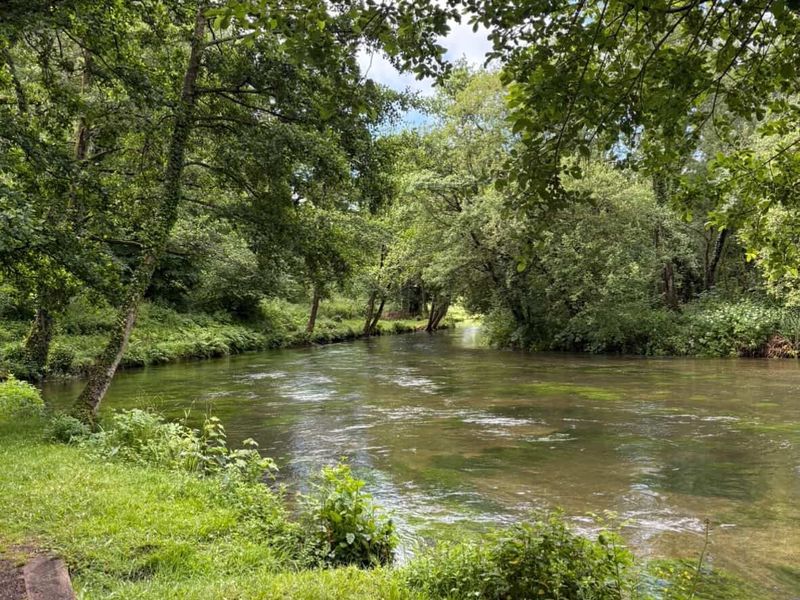
River Itchen
A Hampshire chalk stream rising from springs near New Cheriton, the River Itchen runs 28 miles through the Hampshire Downs, collecting the River Alre and Candover Brook just west of Alresford before turning west through the villages of Itchen Abbas, Itchen Stoke, Martyr Worthy and Easton, entering Winchester across Winnall Moors and continuing south through water meadows to its tidal mouth at Southampton Water. Fed entirely by the chalk aquifer, the river carries naturally hard, alkaline water at a near-constant temperature with a stable base flow, giving it the physical uniformity that distinguishes it from most other river types. It holds designations as both a Site of Special Scientific Interest and a Special Area of Conservation, and phosphorus concentrations in parts of the catchment exceed conservation targets; the Environment Agency has tightened discharge permit limits specifically because of the SAC status, and riparian owners and conservation bodies continue active monitoring and restoration work. The River Itchen carries Atlantic Salmon, Brown Trout, Grayling, Rainbow Trout, Sea Trout, with wild brown trout the primary quarry above Winchester and Atlantic salmon and sea trout present in the lower reaches. Hatches of blue-winged olive and sedge are reliable throughout the season, and mayfly appears, though generally lighter than on the Test or Avon. Most beats are fished upstream on the dry fly to rising fish, a method codified on this very water by F. M. Halford and G. S. Marryat in the nineteenth century; G. E. M. Skues later fished Abbotts Barton for decades and developed nymph technique here as a counterpoint to the dry fly doctrine. Where beat rules permit, nymphing remains effective. Grayling offer sport through the winter months. Above Winchester the river is managed predominantly by clubs and syndicates, with day rods only occasionally available. Below Winchester a mixture of private estates and syndicate waters continues to Southampton. FishingBeats currently lists 19 beats across 5 fisheries on the River Itchen.
Frank Sawyer took it further. He was the river keeper at Netheravon on the Hampshire Avon for most of his working life, and he built a style of fishing around a heavy, sparse, weighted nymph cast upstream to a specific fish, sunk to its level, and drifted to it. His Pheasant Tail Nymph is two materials, copper wire and pheasant tail fibres, and it is still in more fly boxes than almost anything else tied in England. Oliver Kite, who settled at Netheravon in 1958 and learned the method from Sawyer himself, popularised it, and the induced take along with it: lifting the rod tip as the nymph reaches the fish so the fly rises in front of it like a nymph making for the surface. The fish, which was thinking about it, commits. It is one of the most satisfying things you can do with a fly rod and it works because it imitates something that genuinely happens.
The practical version for a visitor is this. Where nymph fishing is permitted, it is the answer for bulging fish, for fish grubbing near the bottom, and for the long stretches of a summer day when nothing is hatching. Keep it small and keep it imitative. Chalk stream nymphing is close-range, targeted and visual, usually to a fish you can see, and it has very little to do with the heavy tungsten and long leaders used on faster freestone rivers. And check the rules, because plenty of beats restrict nymph fishing to part of the season or prohibit it entirely.
When nothing is showing
Most of a season is not a hatch. If you arrive at two in the afternoon in July and the river looks empty, the fish have not gone anywhere.
Work the water rather than the fish. A shrimp pattern along the weed edges, a small nymph through the deeper runs, or a single dry fly drifted down the likely lanes on the chance will all produce. Terrestrials are worth trying in the middle of a summer day, because the food coming off the bank does not care whether anything is hatching. A beetle or an ant pattern tight against the near bank is an underrated cast.
Spend some of the time looking rather than casting. Walking a beat slowly with polarised glasses and finding three fish worth coming back to in the evening is a better use of a dead afternoon than covering the whole beat badly. On water you do not know, that reconnaissance is the difference between a good evening and a hopeful one.
Tackle that suits the water
Nothing exotic is needed, and the outfit that works on a chalk stream is the least aggressive one you own.
- Rod. Nine foot for a 4 weight or 5 weight line covers nearly everything. Some people prefer a little shorter on the small overgrown carriers and a little longer for line control on the wider main river.
- Line. A floating weight forward line is fine. One with a longer front taper lands more gently, which matters more here than it does on most rivers.
- Leader. Long and fine. Twelve to fifteen feet is normal, tapering to 5X for general work and 6X when the fish are on small flies in flat water. A short thick leader dumps the fly line too close to the fish and puts a visible thick tippet right next to the fly.
- Flies. Fewer patterns in more sizes rather than the reverse. Something olive in 14 to 18. An emerger in the same range. A mayfly in season. A sedge in 12 to 14. A black terrestrial. A Pheasant Tail Nymph in 14 to 18, a shrimp pattern, and a spinner. That covers the great majority of chalk stream days, and the days it does not cover are usually not solved by a different fly.
- Waders. Useful, not always allowed and not always needed. Many beats are fished entirely from the bank, and a good number prohibit wading outright to protect the weed and the gravel. Where it is permitted, getting into the water lets you stay below the fish’s eyeline, which is often the real benefit rather than the extra reach.
- Glasses and a hat. Polarised lenses, and a dark brim to cut the glare from above.
Wading, weed and the bank
A few things that are less about catching and more about not doing damage, which on these rivers amounts to the same thing over time.
Wading stirs silt, and silt travels downstream onto somebody else’s water and into the gravel where the fish spawn. Where wading is allowed, stay on clean gravel and out of the soft margins, and keep out of the weed beds.
Between late autumn and spring, trout and grayling cut redds in clean gravel, and those redds are pale patches that look like the best wading in the river. Walking through one destroys a season’s eggs. If you are on the water in the winter for grayling, stay off the bright gravel.
Keep to the paths along the bank where there are paths, and go through gates rather than over fences. The banks of most chalk streams are private, carefully kept, and the fishing exists because of that relationship.
Grayling, and the winter river
The trout season on most chalk streams runs roughly from the spring into the early autumn, with the exact dates varying by beat and sometimes by species. That is not the end of the year.
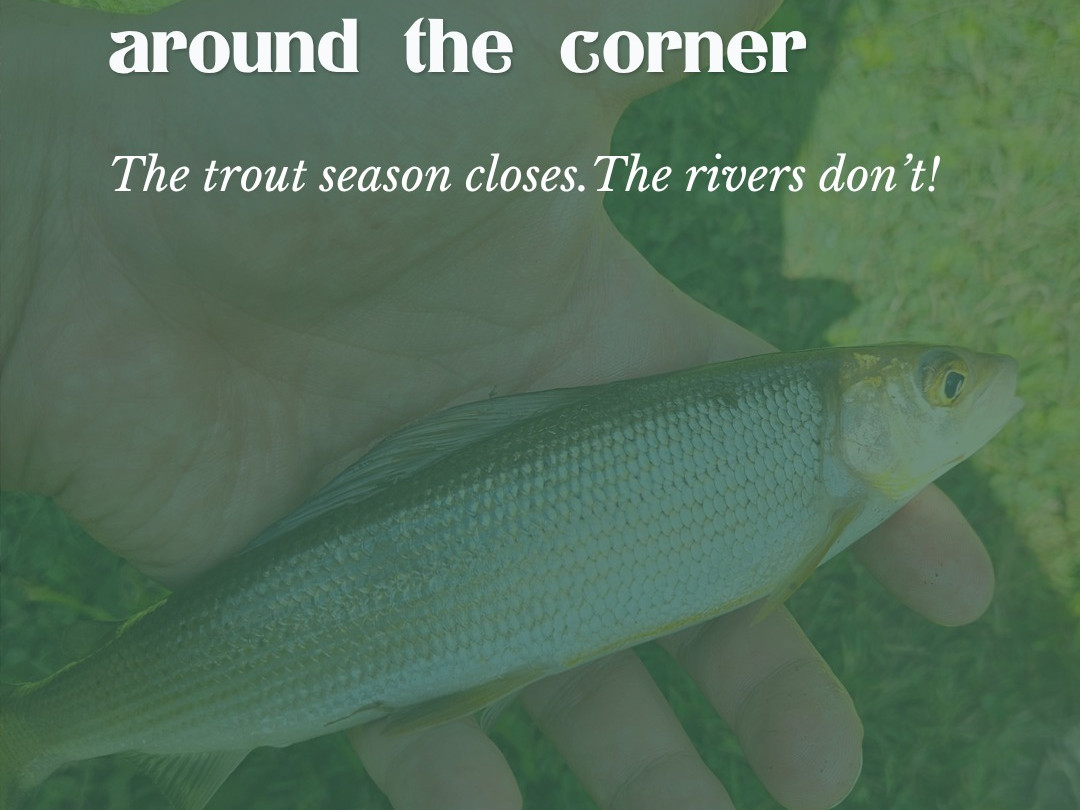
Grayling live in the same water and fish well through the cold months, and a bright frosty day in January on a chalk stream is one of the better things available in English fishing. They shoal, so finding one usually means finding several, and they sit on the clean gravel runs rather than under the banks. They rise to small dries on mild winter afternoons more readily than people expect, usually to midges, and they take a small weighted nymph reliably when they will not come up.
Handling fish
Wild chalk stream trout are not a renewable resource in the way stocked stillwater fish are, and many beats require catch and release, particularly on wild water. Where it is required it is required. Where it is not, it is still worth thinking about.
Barbless or debarbed hooks come off easily and do less damage. A knotless mesh net keeps a fish contained without scraping it. The best thing you can do is keep the fish in the water, unhook it there if you can, and not lift it out for a photograph you have already got a version of. If you do lift it, wet your hands and make it seconds rather than a minute.
This matters most in warm weather. Trout come under real stress above about 19°C, and a fish played hard and released into water that warm can die later even though it swam off looking fine. In a hot spell, fish early, keep fights short, and be willing to not fish at all on the worst afternoons. I wrote more about that in fishing chalk streams in the heat.
The first ten minutes
If all of the above collapses into a habit, it is this one. When you get to the water, do not tie anything on.
- Walk a little of the beat and look at it. Find the weed lanes and the seams.
- Watch for rises, and watch what is drifting down past you at the speed of the current.
- Check where the sun is, and which bank puts your shadow behind you.
- Pick a fish, or a lie that ought to hold one.
- Work out where you would have to stand for the fly to arrive before the line, with as little line as possible lying across a different current.
- Then tie on the fly that matches what you actually saw, get into position from downstream, stay low, and make the first cast count.
That is the whole of it. The clear water, the weed, the food and the upstream tradition are all the same fact seen from different angles, and the fact is that these rivers reward thinking before doing. It is also why a chalk stream fish, once it eats, feels like it was earned.
To find water to try this on, browse the beat map, or look through the rivers to see what runs near you. If cost is the deciding factor, the day ticket price comparison shows what a day actually costs across the chalk streams, and there is more at the cheaper end than most people expect.